Validated on real codebases
Modern syntax, minimal core
C-like syntax with modern conveniences. Function overloads, type inference, generics, struct literals, defer, slices, named arguments.
struct Rect { i32 x, y, w, h; }

bool contains(Rect r, i32 px, i32 py) {
    return px >= r.x && px < r.x + r.w &&
           py >= r.y && py < r.y + r.h;
}

i32 main() {
    print("Hello, world! 🎉\n");
    var box = Rect{ x: 0, y: 0, w: 64, h: 48 };
    print("hit = {}\n", contains(box, px: 10, py: 20));
    return 0;
}
Tiny, fast, and self-contained
The entire compiler self-compiles (~150k lines) to 2.0 MB, with no external dependencies.
Math functions lower directly to CPU instructions, or have minc implementions. All results identical cross-platform.
No runtime, instead calls directly into kernel32.dll on Windows, raw syscalls on Linux, and libSystem.B.dylib on macOS/iOS.
On WebAssembly, a tiny stdlib shim provides core functionality.
Compile times are instant (milliseconds) for small to medium-sized projects.
// Cross-compiler + all targets: ~1950 KB

$ minc run hello.mc
-> hello.exe (2.5 KB) (10 lines)  // 20 ms
Hello, world! 🎉

$ minc sokol_cube.mc
-> sokol_cube.exe (191.0 KB) (124,365 lines)  // 200 ms
Native cross-compilation
A single executable generates Windows, Linux, macOS, iOS, Android and WASM binaries directly. No external assembler or linker needed. Cross-compile from any platform to any target. macOS adhoc codesigning built-in.
JIT module - recompile code with libminc.{dll/so} and hot-swap binaries with a cross-platform API.
// Cross-compile from any platform:

$ minc app.mc --target win-x64     // Windows PE
$ minc app.mc --target linux-x64   // Linux ELF
$ minc app.mc --target macos-arm64 // macOS Mach-O
$ minc app.mc --target wasm        // WebAssembly

// Launches built-in webserver and runs WASM
// --shader-live enables shader live edits
$ minc run --target wasm --shader-live app.mc

// Same source, same compiler, any target.
Just enough ergonomics
Generics, tagged unions with exhaustive pattern matching, type aliases, auto-deref, type inference, function overloading, named arguments, destructuring, range-based for-loops, compile-time format strings, and a module system. Enough modern conveniences to stay productive without the complexity.
union Result<T, E> { Ok(T), Err(E) }    // tagged union

var p = Point{3, 4};        // type inference
var (x, y) = get_pos();     // destructuring
node.next.value;            // auto-deref (no -> needed)

draw(width: 800, height: 600);      // named arguments
for i in 0..n { sum += data[i]; }   // range-based for
print("{} + {} = {}\n", a, b, a+b); // compile-time

T max<T: Numeric>(T a, T b) {     // constrained generic
    return a > b ? a : b;
}
Built-in vector types with auto-SIMD
Vector and matrix types — float4, float4x4, f64x2 —
are first-class types, not library wrappers. Arithmetic on them
lowers to native SIMD instructions (SSE/NEON/WASM-SIMD) on every supported target.
// Built-in vector and matrix types
float4   pos    = float4{x, y, z, 1.0};
float4x4 mvp    = proj * view * model;

// Arithmetic lowers to SIMD (SSE/NEON/WASM-SIMD)
float4 clip     = mvp * pos;
float4 lit      = color * light + ambient;
f32    d        = dot(a, b);
float4 n        = normalize(v);

// Same types used in shaders (@shader) and CPU code.
Built-in shader compiler
Write shaders in minc syntax with @shader annotations.
The compiler translates them to GLSL, HLSL, or Metal depending on
the target API. No separate shader toolchain or offline
compilation step.
Shader live reloading - edit shader while your app is running and see changes directly on file edits. File change API is completely cross-platform.
struct VsOut { float4 pos; float4 color; }

@shader vertex
VsOut cube_vs(
    @attr(0) float4 position,
    @attr(1) float4 color,
    @uniform float4x4 mvp
) {
    VsOut o;
    o.pos = mul(mvp, position);
    o.color = color;
    return o;
}

@shader fragment
float4 cube_fs(VsOut input) {
    return input.color;
}
Predictable numerics, safe defaults
No arithmetic or indexing undefined behavior. Bounds-checked arrays, wrapping arithmetic, mixed signed/unsigned rejected at compile time, and explicit casts for lossy conversions. Defer for deterministic cleanup. Compile-time format strings that can't crash at runtime. Built-in atomics, threads and cooperative fibers.
// Defer: deterministic LIFO cleanup
var fd = open("data.bin", 0);
defer close(fd);
var buf = alloc<u8>(4096);
defer free(buf);
// both freed in reverse order at scope exit

// signed overflow wraps, no UB
i32 x = 0x7FFFFFFF + 1;

// Cooperative fibers
void producer(void* arg) {
    print("step 1\n");
    fiber_yield();
    print("step 2\n");
}

// Threads: built-in, no external library
var t = thread_create(worker, arg);
thread_join(t);
Seamless C interop
Call C functions directly with extern declarations. No import
libraries and no .def files, even for the Windows API. Link COFF, ELF,
and Mach-O objects directly, or let a library bundle its own C shim. minc functions
can be passed back to C as callbacks. minc implements the C ABI on all targets.
// Call C directly: no import libs, no .def files.
when os(windows) {
    extern "user32.dll" i32 MessageBoxW(void* hwnd,
        u16* text, u16* title, u32 flags);
}
when os(linux) {
    // block form: one lib, many fns
    extern "libm.so.6" {
        f64 sin(f64 x);
        f64 cos(f64 x);
    }
}

// A library can carry its own C shim — the @link tag
// follows the #include, so `minc app.mc` just works:
//   lib/audio.mc:  @link "audio_shim.obj"
#include "lib/audio.mc"

// minc functions flow back into C as callbacks
// (minc implements all target C ABI):
extern void set_log_handler(fn(u8*): void cb);
void on_log(u8* msg) { /* ... */ }
set_log_handler(on_log);
Developer tools included
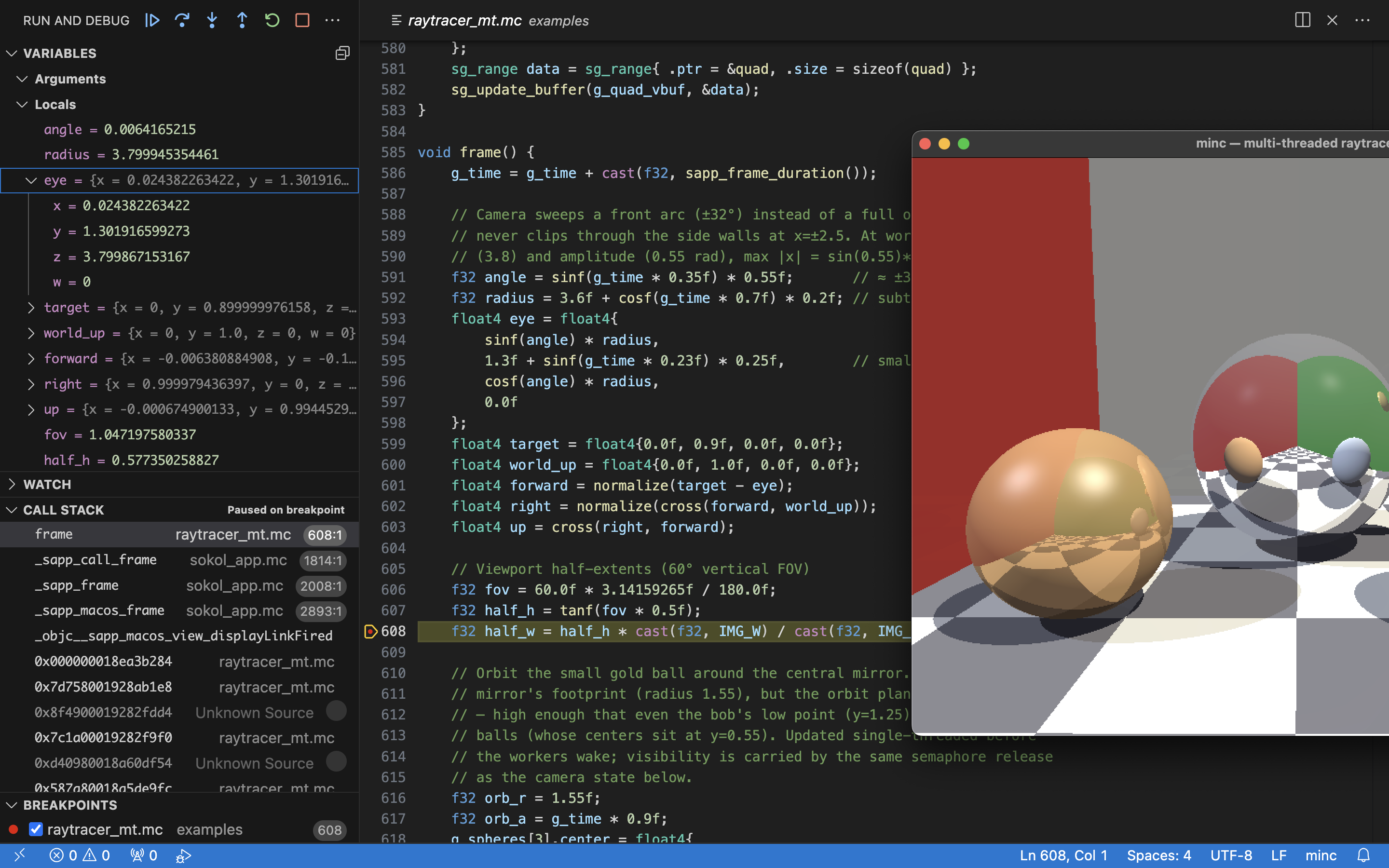
Native debugger (minc-dbg) for Windows, Linux, and macOS — no external gdb or lldb required. A VS Code extension provides syntax highlighting and integrated debugging, backed by a full language server (LSP) for go-to-definition, hover info, and live diagnostics.